
What Is 3D Printing? Everything you need to know!
This post may contain affiliate links. As an Amazon Associate, I earn from qualifying purchases.
As someone who has always been fascinated by technology, I find 3D printing to be one of the most exciting and innovative technologies of our time. 3D printing, also known as additive manufacturing, is a process of creating three-dimensional objects from a digital file. It involves layering materials on top of each other until the object is complete.
Fundamentals of 3D printing include the types of 3D printing technologies, materials used in 3D printing, and the 3D printing process itself. There are several types of 3D printing technologies, including Fused Deposition Modeling (FDM), Stereolithography (SLA), and Selective Laser Sintering (SLS). Each technology has its own advantages and limitations. The materials used in 3D printing include plastics, metals, and even biological materials. The 3D printing process involves converting a digital file into a physical object by layering materials until the object is complete.
Key Takeaways
- 3D printing is a process of creating three-dimensional objects from a digital file.
- The most common types of 3D printing technologies include: Stereolithography (SLA), Fused Deposition Modeling (FDM), and Selective Laser Sintering (SLS)
- The 3D Printing process includes the following phases: Design, slicing, printing and post-processing.
History and Evolution of 3D Printing
I’ve always been fascinated by 3D printing technology, and it’s amazing to think how far it has come since its inception. The history of 3D printing dates back to the 1980s when Chuck Hull, the founder of 3D Systems, invented the first-ever 3D printer called the SLA-1. Since then, 3D printing has evolved into a revolutionary technology that has transformed the manufacturing industry.
The early days of 3D printing were characterized by slow and expensive machines that were only accessible to large companies and research institutions. However, advancements in technology have made 3D printing more affordable, accessible, and versatile. Today, 3D printing is used in various industries, including aerospace, automotive, healthcare, and education.
Over the years, 3D printing technologies have become more sophisticated, allowing engineers to create intricate and complex designs. Some of the most popular 3D printing technologies include Fused Deposition Modeling (FDM), Stereolithography (SLA), and Selective Laser Sintering (SLS). Each of these technologies has its unique advantages and disadvantages, making them suitable for different applications.
Fundamentals of 3D Printing
3D printing is a process of creating a physical object from a digital model. The process involves the use of a 3D printer that reads a digital file and then creates a physical object by adding material layer by layer. The layers are added one at a time until the object is complete.
The first step in 3D printing is to create a 3D model of the object that you want to create. This 3D model can be created using various software programs such as CAD software. Once the 3D model is complete, it is saved as a digital file that can be read by the 3D printer.
The printing process starts by loading the digital file into the 3D printer. The printer then reads the file and begins to create the object layer by layer. The printer uses an additive process to create the object. This means that the printer adds material layer by layer until the object is complete.
The material used in 3D printing varies depending on the type of printer and the object being printed. Common materials used in 3D printing include plastic and metal.The printer uses the material to create each layer of the object until it is complete.
One of the key advantages of 3D printing is its ability to create complex shapes and designs. Because the printer creates the object layer by layer, it can create intricate designs that would be difficult or impossible to create using traditional manufacturing methods.
Types of 3D Printing Technologies
As 3D printing technology has evolved, different types of printing technologies have emerged. Here are the most common types of 3D printing technologies:
Stereolithography (SLA)
Stereolithography (SLA) is a type of 3D printing technology that uses a liquid resin and a UV laser to create a solid object. The laser hardens the resin layer by layer, creating the desired shape. SLA is known for its high accuracy and smooth surface finish, making it ideal for creating detailed and intricate parts.
Fused Deposition Modeling (FDM)
Fused Deposition Modeling (FDM) is a popular 3D printing technology that uses a thermoplastic filament as the printing material. The filament is heated and extruded through a nozzle, which moves along the X, Y, and Z axes to create the desired shape. FDM is known for its affordability and versatility, making it ideal for creating functional prototypes and low-volume production parts.
Selective Laser Sintering (SLS)
Selective Laser Sintering (SLS) is a 3D printing technology that uses a high-powered laser to fuse small particles of plastic, metal, or ceramic powder into a solid object. The laser selectively sinters the powder layer by layer, creating the desired shape. SLS is known for its ability to create complex geometries and functional parts with high strength and durability.
Direct Metal Laser Sintering (DMLS)
Direct Metal Laser Sintering (DMLS) is a 3D printing technology that uses a high-powered laser to fuse metal powder into a solid object. The laser selectively sinters the metal powder layer by layer, creating the desired shape. DMLS is known for its ability to create complex geometries and functional metal parts with high strength and durability.
Digital Light Processing (DLP)
Digital Light Processing (DLP) is a 3D printing technology that uses a projector to cure a liquid resin into a solid object. The projector shines a pattern of light onto the resin, hardening it layer by layer to create the desired shape. DLP is known for its high resolution and speed, making it ideal for creating small, intricate parts.
No products found.
Materials Used in 3D Printing
When it comes to 3D printing, there are a variety of materials that can be used to create objects. These materials can be broadly categorized into plastics, metals, ceramics, and polymers. Let’s take a closer look at each of these categories.
Plastics
Plastic filaments are the most commonly used materials in 3D printing. PLA (polylactic acid) is one of the most popular types of plastic used in 3D printing. It is made from renewable resources and is biodegradable, making it an environmentally friendly option. ABS (acrylonitrile butadiene styrene) is another popular plastic used in 3D printing. It is a strong and durable material that is commonly used to create toys, car parts, and other objects.
Metals
Metals are also commonly used in 3D printing. Metal powder is used to create objects using a process called powder bed fusion. This process involves melting the metal powder with a laser to create the object layer by layer. Popular metals used in 3D printing include titanium, stainless steel, and aluminum.
Ceramics
Ceramics are a newer material used in 3D printing. They are made from a mixture of clay and other materials and are used to create objects such as vases, bowls, and other decorative items. Ceramic 3D printing is still in its early stages, but it is expected to become more popular in the future.
Polymers
Polymers are a broad category of materials that includes plastics, rubber, and other materials. Nylon is a popular polymer used in 3D printing. It is a strong and flexible material that is commonly used to create objects such as gears and other mechanical parts. Carbon fiber is another polymer that is used in 3D printing. It is a strong and lightweight material that is commonly used to create objects such as bicycle frames and other sports equipment.

- 【Beginner-Friendly Small Spool Filament Pack】Perfect for 3D printing beginners! This 250g × 8-color PLA filament bundle uses compact 250g mini spools, ideal for testing multiple colors without committing to full 1kg rolls. Please carefully check spool size before purchasing: each spool measures approximately 140mm in outer diameter, 36mm in width, and has a 53mm center hub hole. These mini spools are compatible with most open-frame and top-load printers but may not fit printers that require large 1kg spools or enclosed spool bays. Compact, lightweight, and easy to swap—perfect for experimentation and color exploration.
- 【High-Quality PLA Material】: Made from premium PLA, this filament offers a low melting temperature, minimal warping and shrinkage, and a smooth, glossy surface finish. It is odorless during printing and safe for indoor use.
- 【Neatly Wound for Stable Feeding】: Produced with SUNLU’s precision winding process, the filament is neatly spooled to support smoother feeding and help reduce tangling, jamming, and filament breakage during printing. For best results, please check the spool condition after opening the bag, and keep hold of the filament end when loading to avoid sudden tension release that may cause loose coils.

- ①【SUNLU PLA 3D Printer Filament Bundle】2kg in Total, 8 Spools of 250g SUNLU 1.75mm PLA filament. Multiple Color Choices, 8 colours: Black+White+Grey+Transparent+Red+Blue+Orange+Green. Multiple colors satisfy your rich 3d printing creativity.
- ②【SUNLU 250G Spool Diameter】Spool Diameter: 140mm(5.51 inches), Spool Width: 36mm(1.42 inches), Spool Hub Hole Diameter: 53mm(2.09 inches)
- ③【High Compatibility】Search for 250g spool adapter on printing platforms such as Makerworld to print out the adapter. After installing the 250g spool adapter SUNLU 250g PLA Filament is perfectly compatible with AMS.
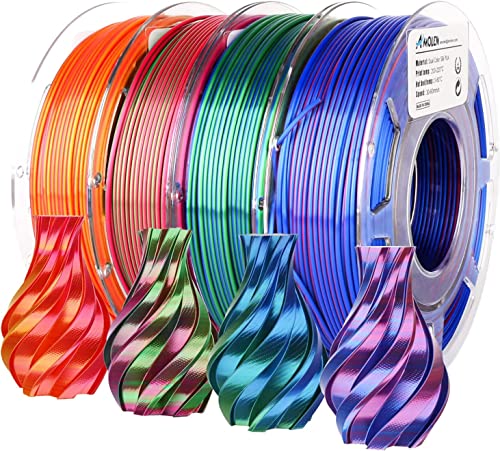
- Colorful Variety 4 Pack: Each color weighs 200 g, providing a total of 800 g. Dive into the vibrant world of 3D printing with AMOLEN silk multicolor PLA filament pack, featuring stunning shades. Even small models can display multiple colors
- Silk Dual Color PLA: Experiment with multiple hues without the commitment of larger spools. You can print beautiful multicolors in one PLA filament, perfect for arts, crafts, DIY. Whether you're crafting Easter decorations, designing Halloween costumes, creating Christmas ornaments, or making Valentine’s surprises, this filament delivers stunning results every time
- Precision Printing: Achieve flawless prints with shiny silk dual color PLA filament, engineered for ease of use and exceptional precision. With a product diameter of 1.75 mm and precision tolerance of +/- 0.02 mm, smooth and consistent results
3D Printing Process
As someone who has been working with 3D printing for a while, I can say that the process can be broken down into four main steps: Design, Slicing, Printing, and Post-Processing.
Design
The first step in the 3D printing process is designing a 3D model on a computer using 3D software. The design can be created from scratch, or an existing model can be downloaded and modified. The design should be created with the manufacturing process in mind, taking into account the limitations of 3D printing technology.
Want to get started with a basic TinkerCad project? Check out our name tag tutorial!
Slicing
Once the design is complete, it needs to be prepared for printing. This is done using slicing software, which takes the 3D model and slices it into thin layers. The slicer then generates a printable file that the 3D printer can understand. The slicing process can be customized to adjust the layer height, infill density, and other settings that affect the final print.
Printing
The next step is printing the 3D model. The most common 3D printing technology is Fused Filament Fabrication (FFF), also known as Fused Deposition Modeling (FDM). FFF works by melting plastic filament and extruding it through a nozzle onto a build plate. The printer builds up the model layer by layer, following the instructions in the printable file generated by the slicer.
Post-Processing
Once the print is complete, the final step is post-processing. This can involve removing the print from the build plate, removing support structures, and sanding or painting the model to achieve the desired finish. Post-processing can be time-consuming, but it is an important step in achieving a high-quality final product.
Applications of 3D Printing
3D printing has revolutionized the manufacturing industry, making it possible to create complex designs and prototypes quickly and efficiently. In addition to manufacturing, 3D printing has numerous applications in healthcare, automotive, and aviation industries.
Manufacturing
One of the main applications of 3D printing is in manufacturing. 3D printing allows manufacturers to create complex designs and prototypes quickly and efficiently. This technology has made it possible to create end-use parts, which can be used in the final product. 3D printing is also used in casting, which allows for the creation of intricate molds that can be used to cast metal parts.
Healthcare
3D printing has also had a significant impact on the healthcare industry. It has made it possible to create custom prosthetics, which can be tailored to the individual patient’s needs. This technology has also made it possible to create models of organs and body parts, which can be used to plan surgeries and other medical procedures.
Automotive
The automotive industry has also benefited from 3D printing technology. It has made it possible to create complex parts and prototypes quickly and efficiently. This technology has also made it possible to create spare parts for older vehicles, which can be difficult to find.
Aviation
The aviation industry has also embraced 3D printing technology. It has made it possible to create lightweight parts and components, which can reduce the weight of the aircraft and improve fuel efficiency. This technology has also made it possible to create complex parts and prototypes quickly and efficiently.
Advantages and Limitations of 3D Printing
As a 3D printing enthusiast, I have come to appreciate the numerous advantages that this technology offers. However, it is important to note that 3D printing also has its limitations. In this section, I will highlight some of the advantages and limitations of 3D printing.
Advantages of 3D Printing
1. Rapid Prototyping: One of the biggest advantages of 3D printing is its ability to produce parts quickly. With 3D printing, it is possible to design, manufacture, and test a customized part in as little time as possible. This is especially useful in product development where rapid prototyping can help to speed up the design process.
2. Flexible Design: 3D printing allows for the design and print of more complex designs than traditional manufacturing processes. More traditional processes have design restrictions which no longer apply with the use of 3D printing. This means that designers can create more intricate and complex shapes and structures.
3. Precision and Repeatability: 3D printing allows for high precision and repeatability. This means that parts can be manufactured to a high level of accuracy and consistency.
4. Cost-effective: 3D printing can be cost-effective, especially for small production runs. This is because there is minimal tooling required, and the cost of producing parts is relatively low.
Limitations of 3D Printing
1. Limited Material Selection: 3D printing is limited by the materials that can be used. While there are a wide range of materials available, the selection is still limited compared to traditional manufacturing methods.
2. Surface Finish: The surface finish of 3D printed parts is not as smooth as parts produced using traditional manufacturing methods such as injection molding. This can be a limitation in applications where a smooth surface finish is required.
3. Size Limitations: 3D printers have size limitations, which means that parts larger than the printer’s build volume cannot be produced in one piece. This can be a limitation in applications where large parts are required.
4. Production Time: While 3D printing can be fast for small production runs, it can be slower for larger production runs. This is because each part has to be printed individually, which can be time-consuming.
Future of 3D Printing
As someone who has been following the evolution of 3D printing technology, I am excited about the potential it holds for the future. In particular, I believe that on-demand manufacturing will be one of the most significant applications of 3D printing in the years to come. With 3D printing, it will be possible to manufacture products as and when they are needed, rather than having to rely on centralized factories and supply chains.
Another area where I see 3D printing having a significant impact is in the hobbyist market. 3D printers are becoming more affordable, and this is opening up new opportunities for hobbyists to create their own products. This democratization of manufacturing is exciting because it means that anyone with a good idea can turn it into a reality.
In terms of manufacturing, 3D printing is often compared to subtractive manufacturing, which involves removing material from a larger block to create a product. While subtractive manufacturing has its advantages, 3D printing is much more versatile. It can create complex geometries that would be impossible to achieve with subtractive manufacturing methods.
One of the most exciting areas of research in 3D printing is the use of living cells to create tissues and organs. While this technology is still in its infancy, it has the potential to transform healthcare by making it possible to create organs for transplant patients on demand.
Overall, I am confident that 3D printing will continue to play an important role in manufacturing and product development in the years to come. Its versatility and flexibility make it an exciting technology to watch.
Frequently Asked Questions
3D printing has a wide range of applications in various industries such as aerospace, automotive, healthcare, and fashion. Some common applications of 3D printing include rapid prototyping, product design, medical implants, dental models, jewelry, and architectural models.
Chuck Hull is credited with inventing 3D printing. He invented stereolithography (SLA) in 1983, which is a type of 3D printing technology that uses a laser to solidify layers of resin.
There are many materials that can be used in 3D printing, including plastics, metals, ceramics, and even food. The most commonly used materials in 3D printing are thermoplastics such as ABS and PLA.
3D printing has the potential to revolutionize the way we live in our homes. Some potential uses of 3D printing in the home include printing custom furniture, kitchen utensils, toys, and even replacement parts for household appliances.
The main benefit of 3D printing technology is its ability to create complex shapes and geometries that would be difficult or impossible to produce with traditional manufacturing methods. 3D printing also allows for rapid prototyping and customization, which can save time and money in product development.
As 3D printing becomes more widespread, there are many legal implications to consider. For example, intellectual property laws may need to be updated to account for the ease of reproducing copyrighted objects. Additionally, there may be safety concerns with printing certain objects, such as weapons or medical devices.

Kate is mom of two rambunctious boys and a self-proclaimed super nerd. With a background in neuroscience, she is passionate about sharing her love of all things STEM with her kids. She loves to find creative ways to teach kids computer science and geek out about coding and math. She has authored several books on coding for kids which can be found at Hachette UK.


